
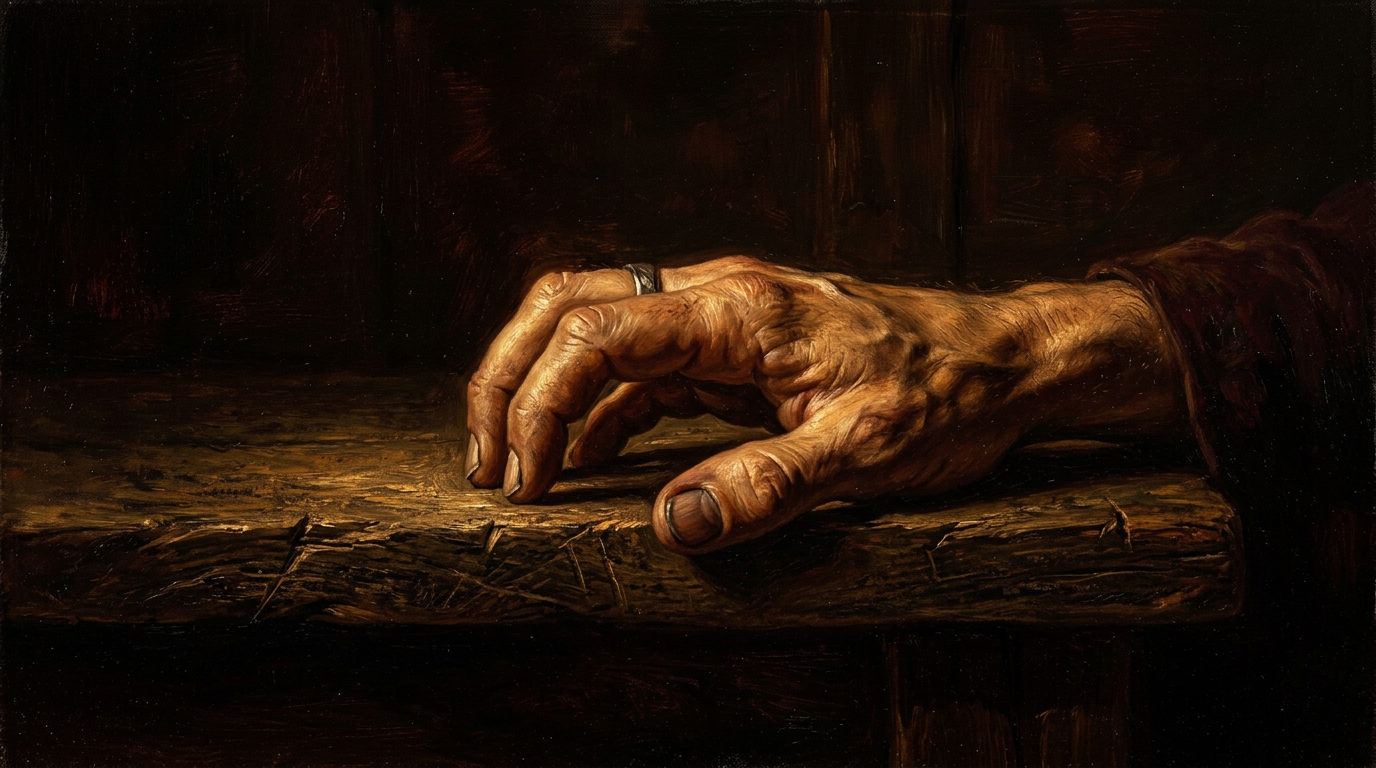
I remember an evening a few years ago. A long conversation, an important decision looming. I was tired, my whole body crying out for rest. Yet I forced myself to be alert and rational. The decision I made felt logical at the time. The next morning, after a night's sleep, I saw everything differently. I had completely misjudged my counterpart's arguments, driven by an unconscious desire simply to end the conversation. I hadn't decided with my free mind, but with my exhausted body.
This experience was a wake-up call for me. I began to understand that people like to see themselves as spiritual beings, above such things. We think we make our judgments based on facts, logic, and values. Yet often, our thinking is merely the retrospective advocate for impulses that originate in our bodies.
The truth is often much simpler and more grounded. Our physical states, our hidden emotions, and our deeply ingrained habits hold immense power over us. A power that can burden our soul if we fail to recognise it.
The Illusion of Mental Freedom
Think about your daily life. How often do you make decisions that are significantly shaped by your physical condition? When you're hungry, you become impatient and irritable. When you're stressed, you see problems and dangers everywhere. A lack of sleep doesn't just make you tired; it alters your entire perception of the world, making everything seem grey and arduous.
Pain, whether physical or emotional, narrows our focus. Suddenly, everything revolves around getting rid of that pain. The allure of pleasure or sexual arousal can overturn every good intention. An inner restlessness drives us to reach for our phone, open the fridge, or start an unnecessary argument – anything to avoid feeling that unpleasant sensation.
We consider ourselves captains on the bridge of our lives. Yet, in truth, we are often just passengers whose course is determined by the currents and storms of our bodies. Our mind is a master at finding plausible explanations, after the fact, for all these unconsciously driven actions. "I've earned this chocolate," we say, though in reality, it was the body craving a quick energy boost to numb a feeling of emptiness.
The Body as Helmsman
Our body isn't merely a vessel for our spirit. It's an incredibly complex system that constantly learns and adapts. Every experience, every repetition, carves pathways into our nervous system. This is how habits form – motorways in the brain that steer our behaviour along a predictable route.
When an action leads to a pleasant feeling, be it the satisfaction of eating, the relaxation from a TV series, or the validation of a 'like' online, our body wants more of it. An expectation is built up. The mere thought of the reward can trigger the impulse to repeat the action. This happens in a flash, far below the threshold of our conscious thought.
The body acts like an autopilot. It controls our reactions based on past experiences to conserve energy and get us safely through the day. This isn't inherently bad. But it becomes a problem when the autopilot leads us to places our heart and soul don't want to go. When habit has us firmly in its grip and we realise we are no longer free to choose.
Living for a Feeling
Let's look even deeper. Why do we do what we do? Ultimately, most of us are constantly chasing certain feelings or trying to avoid others. We don't strive for food itself, but for the feeling of satiety and comfort. We don't seek the sexual act, but the feeling of pleasure, intimacy, and affirmation. We don't consume to own things, but for the feeling of novelty, belonging, or status.
Conversely, the same applies. We distract ourselves with work, entertainment, or social media to avoid having to endure feelings of emptiness, anxiety, or boredom. We try to control everything to avoid the unbearable feeling of uncertainty and powerlessness.
Our entire life can become a subtle hunt for the next good feeling. It's an unquenchable thirst, for every feeling is fleeting. No sooner is satisfaction achieved than it ebbs away, and the search begins anew. This is an exhausting, soulless game. It leaves an inner emptiness because it keeps us from what truly nourishes: genuine relationship, stillness, and connection with God.
Addictions, Sexuality, Food, and Control
Some of these drivers are so powerful that they can completely dominate us. An addiction is nothing more than an automatism where the body has taken over control entirely. The mind may know it's harmful, but the physical craving for the feeling of reward is overwhelming.
Sexuality is one of the strongest forces within us. It is intended by God as something good and unifying. Yet, detached from a deep, committed relationship, it often becomes a mere commodity. Images and stimuli on the internet promise quick pleasure, but often leave a deep inner conflict and loneliness. The body gets its quick gratification, but the soul withers.
Food is vital for survival, yet for many, it becomes a substitute for comfort and security. Eating can temporarily dampen feelings of stress and sadness. But it doesn't solve the underlying cause; instead, it often leads to a cycle of shame and more eating.
The desire for control and security is also deeply ingrained within us. In an uncertain world, we try to gain a sense of power through planning, order, and safeguards. Yet this attempt is doomed to fail. Life remains unpredictable. Clinging to the illusion of control leads to constant tension and fear of the unknown.
Our Senses as a Gateway
Our feelings are not generated in a vacuum. They are triggered by what we take in through our five senses. A particular scent can instantly transport us back to our childhood. A loud, aggressive noise immediately creates stress. The gentle light of a sunset can fill us with peace.
We are often unaware of how much our environment shapes our emotional world. An untidy room can create inner restlessness. The constant flood of images, news, and opinions from our digital devices continuously triggers small emotional reactions – curiosity, envy, anger, fear. This overstimulation exhausts our system and makes it difficult to find peace and hear a clear inner voice.
The impulse to respond to a message or scroll through a feed is often triggered visually or acoustically, long before we make a conscious decision to do so. Our senses are the open gates to our soul. What we let in shapes who we are and how we feel.
When Worlds Collide
Another important point has struck me: everyone experiences the world through their own unique filter. Your physical condition, your personal history, and your innate sensitivity to stimuli determine how you perceive a situation.
Imagine a married couple. He is more visually oriented, perceiving the world through what he sees. For him, a room is tidy as long as the big things are in their place. She, on the other hand, is very sensitive to sounds, smells, and the general atmosphere. The same living room that is tidy for him feels chaotic and noisy to her because the radio is playing, the dishwasher is humming, and small items are scattered everywhere.
Neither of them is wrong. They experience the same reality in completely different ways. Conflicts arise when one person holds their perception to be the only valid truth. He doesn't understand why she is "so sensitive." She feels misunderstood and disrespected because he doesn't perceive her distress. Such differences in perception are one of the most common causes of misunderstandings in relationships. We don't argue about the facts, but about our respective feelings triggered by those facts.
Where Does Freedom Begin?
So, what is the way out of this control by the body? It's not about fighting the body or suppressing feelings. That would be a hopeless battle. The path to freedom begins with honest perception.
The first step is to become an observer of yourself. Notice what is happening within you, without immediately judging it. "Ah, I'm tired and now have a strong impulse to eat something sweet." Or: "This person said something that triggers a feeling of anxiety in me, and now I want to defend myself." This very act of observing creates a small but crucial distance between the impulse and your reaction.
In this brief pause lies freedom. You don't have to follow the impulse immediately. You can breathe. You can choose. Perhaps you still eat the chocolate, but you do it consciously and no longer as a slave to an unconscious programme.
Another crucial step is to reduce unnecessary stimuli. This doesn't mean withdrawing from the world. It means consciously deciding what you allow to affect you. You don't have to reply to every message instantly. You can put your phone away for a few hours. You can consciously schedule times of stillness into your day, without music, without podcasts, without distraction.
By reducing the flood of stimuli, you give your nervous system a chance to settle. You sharpen your senses for what is essential. You learn to take other people's perceptions more seriously, without having to abandon your own.
Jesus said to him, "I am the way, and the truth, and the life. No one comes to the Father except through me." John 14:6
True freedom is not found in perfect self-control. That would again be merely an achievement that puts us under pressure. The freedom I speak of is a fruit of relationship with Jesus Christ. He knows our human frailty, our physical drives, and our emotional distress.
When we learn to listen to our body without obeying it, we create space. Empty space. Still space. In this space, our soul can breathe. In this space, we can hear the quiet voice of God. Freedom from the dictates of our impulses is freedom for Him. It is the freedom to no longer be driven, but to live and love from a deep inner peace and connection.