
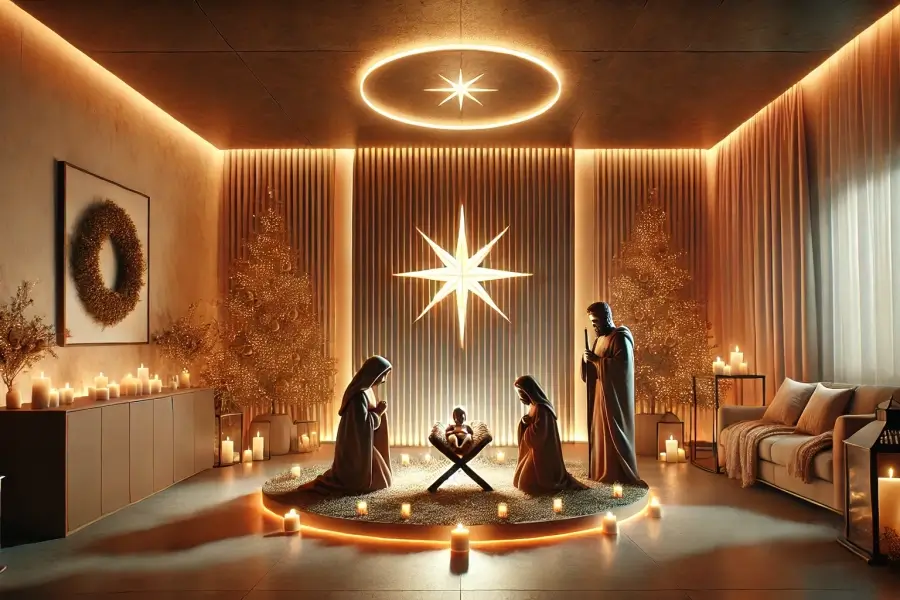
The title probably brings to mind one of the most well-known Christmas carols among Christians. This piece isn't meant to be a clichéd look at Christmas, but rather a deeper exploration of the true meaning behind Christ's birth.
Christmas, the festival of love, the birth of Christ – truly the most wonderful time of the year.
God became man. Where else does that happen? At its core, that's the meaning of Christmas. God didn't just send His Son to Earth, as one might imagine. No, as part of the divine Trinity, He became human – in the person of Jesus Christ.
How glorious it is for us as Christians! The Creator exists in three forms, yet we are far from polytheism. The fact that such profound truths could be proclaimed over 2,000 years ago already shows the immense truth revealed in the Bible. Not to mention the over 300 passages in the Old Testament that point to Jesus and speak of events that unfolded exactly as predicted – things that defy all mathematical probability.
But that's not what I want to focus on here. I want to talk about the supernatural gift that Christmas truly is – far removed from the material presents that our commercialised celebration of this festival often almost exclusively prioritises today. In a way, though, it's also important that we humans come together once a year and exchange gifts. I find that very valuable. But if you look closely, there's so much more behind everything Christmas offers.
It's about nothing less than the salvation of our souls – our own salvation. For we humans, as you can see everywhere you look, can be very dangerous beings. Imagine a father with many children: some wonderful, almost angelic; others have strayed a little; and still others are barely manageable. This father faces the almost impossible task of raising all his children with love and respect to be good people.
This is how I see the deepest meaning of life. With birth, whether we want to or not, we accept the task of life. From birth to the grave, we must prove ourselves and try to shape the soul we can take with us. After we leave our bodies and are allowed to return home – or perhaps not – our task remains to master life and secure a divine existence for ourselves. That makes sense. And sense, in this context, is ultimately the deeper meaning of life.
Often, you hear people ask the classic questions: "How can a loving God, who truly loves us above all else, allow all this suffering? How does that make sense?" Or: "How can God send His Son into the world and then let Him die on the cross like that?"
Two fundamental questions that have also deeply occupied me on my journey with Jesus, and for which I have found the following answers:
With birth, we become bound to matter – to flesh and blood. Everything we perceive is determined by two forces. One could call it a dual world: good and evil, day and night. These forces are intertwined, and life is the boundary between being and non-being.
The Creator, the origin of everything, is surely faced with the challenge of allowing these forces to operate in justice and freedom. The first fall from grace, which separated us from God, symbolically fits the creation of the world.
The scientist Stephen Hawking once said that everything could only come into being because something didn't go as it should. If everything had gone perfectly, nothing would have come into existence at all. Although he wasn't a believer, when I heard his words, I immediately thought: That fits perfectly with Genesis and our lives.
The Creator has given us complete freedom. This is comforting: we don't have a commanding God, but a God of freedom. In life, we can do what we wish – develop ourselves wonderfully or not. Human freedom is the highest good God bestows upon us. But this freedom also means that evil is allowed to exist.
So why does God permit suffering? Because it is the purpose of the world. Freedom, development, and improvement are essential. If God visibly intervened, evil would immediately hide behind good.
God's greatness, combined with the freedom of our existence, necessitates a place like Earth so that truth can become visible. A life is like an invisible filter, through which ultimately only the creative can pass.
And now to the question: How can He give up His beloved Son? The great gift of Christmas lies in Him giving Himself – in the person of Jesus.
Whoever understands this has understood the most important thing in life. We have a God who takes on the same burdens we must. That is incredible, but it is a comforting truth. More than that: He even gave Himself up physically in an extreme way – something, thankfully, we no longer have to do in that form.
Praised be the birth of the Redeemer, thank You God the Father, Son & Holy Spirit.
I wish you a wonderful Christmas, many gifts, much love, and the power of good.
Damian Maxson, Christmas 2024 in the beautiful Swiss mountains.