
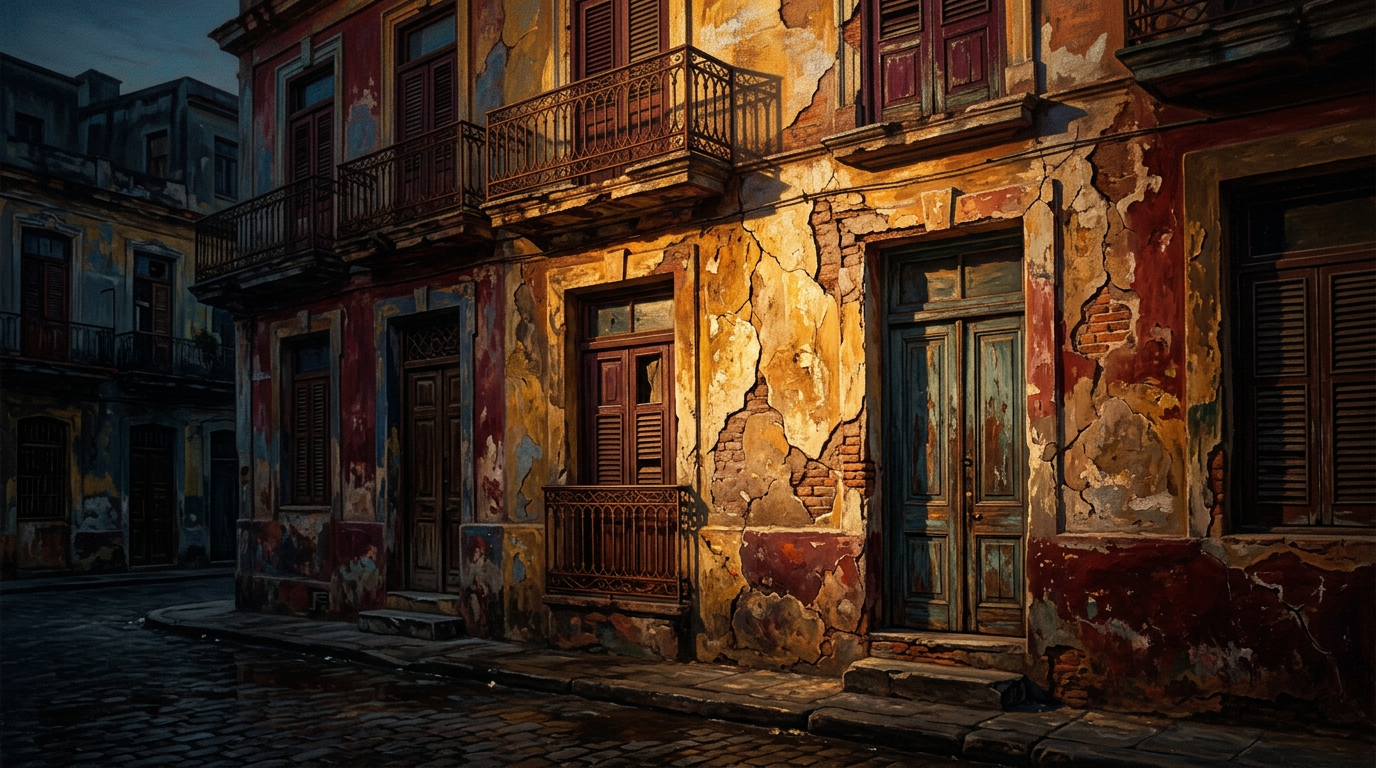
When I first set foot on Cuban soil, my immediate thought was: "I need to get out of here." I was utterly shaken. Completely unprepared, I was hit by the reality of a country scarred by sixty years of political and economic blockades.
Everything seemed to be crumbling. Havana's magnificent colonial buildings were mere peeling shells of their former selves. Everywhere I saw the marks of stagnation, a heaviness that seemed to hang over the entire island. It was the first time I'd seen with my own eyes what a communist system meant for people in their daily lives. Long queues outside almost empty shops. Infrastructure that reminded me of the poorest countries in Africa.
Even as a tourist, you were branded. You felt the invisible divide, the artificial world created for visitors. Yet even this couldn't hide the omnipresent scarcity. I was trapped in my own judgment, seeing only what was broken, difficult, negative. I no longer understood the world and just wanted to return to my orderly Switzerland.
The Forced Return
I probably would never have flown to Cuba again. But life had other plans. My partner, the woman I want to share my life with, is from there. So love compelled me to return. I travelled there a second time, not as a tourist, but as part of a family.
I arrived with resistance in my heart. I expected once again the burden, the scarcity, and the desolation. I braced myself for the difficulties I knew. But because I had to stay, because I couldn't simply flee, I began to look more closely. I had to.
And Then I Saw the People
That second look changed everything. Because my focus was no longer on the crumbling facades and the inadequate supplies, I suddenly noticed the people. I no longer just saw what they lacked, but how they managed with what they had. I saw how they lived.
And they lived! They sat on their doorsteps, talking to each other, laughing heartily. Children played in the street with the simplest things, yet radiated an untamed joy. Music drifted from the houses. It was a scene that stood in stark contrast to my first impression. These people, who in my eyes owned nothing, seemed richer than many people back home in Europe.
In Switzerland and Europe, I often feel constant pressure. The pressure to achieve more, to have more, to keep up. An incessant stress that leaves people tired and often unhappy. In Cuba, I saw the opposite. Not that there's no stress there – their daily life is a constant struggle. But they had a joy for life, an ability to savour the moment, which I often miss in our society. They have learned to live with the minimum, but to draw the maximum out of life.
What Truly Matters
Strangely, it was Cuba that taught me to be content with less. This stark contrast between material scarcity and human abundance exposed a lie in my own life. The lie that happiness and contentment depend on external circumstances, on possessions, or on a smooth daily routine.
I realised what truly matters: people, relationships, community. When everything that distracts us and that we take for granted falls away, then what truly sustains us becomes clear. Cubans know what basic provisions mean. But they also know that the provision for the soul cannot be found in shops.
This experience deepened my faith. It humbled me. Sometimes God might need to lead us into a situation that shocks and challenges us, so we can recognise the essential things once more. It is only in contrast to darkness that we recognise the light. It is only in scarcity that we learn to appreciate the abundance that is not of this world.
I can do all things through Christ who strengthens me. Philippians 4:13
This verse took on a new meaning for me in Cuba. I saw people living this truth every day. Not because they are particularly devout, but because life compels them to. And in that lies incredible strength and beauty.
Today, I enjoy travelling to Cuba, even though the situation has, if anything, worsened since then. But I now see the country with different eyes. I no longer just see the decay, but the resilience. I no longer just hear the complaints, but also the laughter. And I am reminded that the greatest joy is often found where we least expect it. Sometimes, it takes contrast to bring things back into focus.