
Recently, I was sitting with a good friend. We talked about this and that – work, family, the worries that occupy our minds. At some point, he said something that has stayed with me ever since: "We actually have everything, don't we? And yet, it feels like we're just treading water." That sentence resonates deeply because it perfectly encapsulates a profound truth about our Western world. We live in an abundance our ancestors could only have dreamed of. We have opportunities, freedoms, and a material prosperity that is historically unprecedented. And yet, a strange emptiness spreads, an inexplicable restlessness, a deep longing for "more."
I observe this everywhere. In the perfectly curated résumés on professional networks, in the glossy facades of social media, in the relentless pursuit of self-optimisation. The grand project of our time seems to be the "self." We polish it, we nurture it, we place it at the centre. We are the curators of our own little exhibition, the main characters in our own film. The self has become the measure of all things, perhaps even a kind of deity we worship. Yet this deity is an insatiable tyrant. It constantly whispers to us that we are not enough, not successful enough, not happy enough, not… enough.
The paradox is that this gnawing dissatisfaction often seems to play a lesser role in parts of the world that possess far less materially. This is not a glorification of poverty, far from it. It is an observation of the heart. Where scarcity is commonplace, the eye for what truly matters seems sharper. Perhaps because there, one doesn't succumb to the illusion that one can construct one's own salvation.
A Familiar Pattern
When I reflect on this, an ancient story inevitably comes to mind. It's found in the Bible. The people of Israel had just been freed from slavery in Egypt – an incredible act of liberation by God. They were on their way to a promised land, to a future of freedom. But when their leader Moses was on a mountain to receive God's instructions, they grew impatient. The silence and the waiting were unbearable for them.
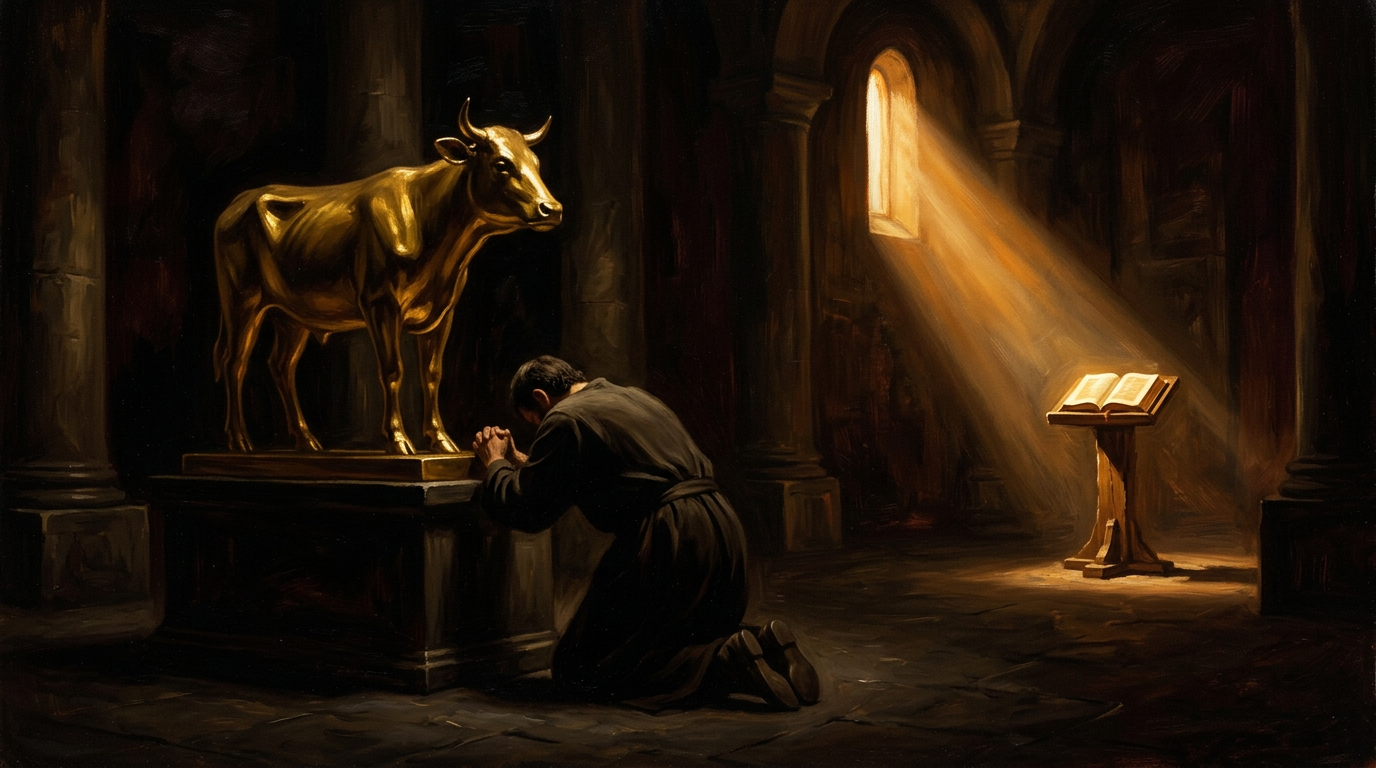
They were afraid. They wanted something tangible, something visible, something they could control. So they gathered all their gold and fashioned a calf. An idol. A god in their own image, made by their own hands. They danced around it, they celebrated it. They replaced the living, invisible God who had freed them with a dead piece of metal. The consequence was tragic: they wandered in the desert for forty years. A whole lifetime searching for a home they had almost reached.
Do we see the parallel? We, too, live in a time of unparalleled freedom. And we, too, grow impatient with the silence. We can barely tolerate not being in control. So we create our own gods. They are not made of gold, but they are no less real. They are the gods of success, of prestige, of self-realisation, and of personal happiness. At the centre of all these gods stands the golden calf of the self. And the result? We wander aimlessly. In a desert of fear, burnout, loneliness, and the constant chase for the next thrill that will make us forget, for a moment, how lost we feel.
What Struck Me
I recall a trip to a country in Southeast Asia many years ago. I was in a small village, far from the tourist crowds. The people there possessed almost nothing, by our standards. Their huts were simple, their food modest. But what I experienced there was a joy and warmth that deeply humbled me. I saw a faith that wasn't just confined to church on Sunday but permeated their entire lives.
Their trust in God wasn't some abstract theory; it was their daily reality. They knew they weren't the architects of their own destiny. Their empty hands made them open to the one who alone can give. I'm not saying their lives were easy. But they had an anchor, a centre that wasn't themselves. This gave them a dignity and a hope that all our prosperity often fails to generate. It's as if our full hands and packed schedules leave no room for God.
For the Son of Man came to seek and to save the lost. Luke 19:10 (NIV)
This experience forever changed my view of our own society. We are so busy building our own little kingdoms that we lose sight of the true King. The one who doesn't feed us empty promises but genuinely wants to bring us home.
When Religion Obscures the View
Now, here's the crucial point. Many people in our society don't turn away from God because they consciously reject him. They turn away because they are repulsed by what they perceive as "religion." They see rigid rules, dusty traditions, abuse of power, and a self-righteous attitude. They see people "practising" religion and confuse that with what it's truly about.
This is perhaps the greatest tragedy of all. When the church, the denomination, or Christian culture itself becomes a kind of golden calf. A system that obscures the view of the living Jesus Christ instead of clearing it. Jesus himself had his greatest confrontations not with sinners and the lost, but with the religious elite of his time. With those who thought they had God trapped in their legalistic boxes and knew exactly how he ought to be.
The message of Jesus was and is revolutionary. It shatters the boundaries of denominations and human systems. It's not about belonging to a specific group or ticking off a list of rules. It's about encountering a person: Jesus Christ.
It's About the One, Good News
The word "Gospel" sounds old and foreign to many. But it simply means: the good news. And this message is astonishingly simple. God didn't create this world for us to spin in circles around ourselves until we collapse from exhaustion. He created it to have fellowship with us. To draw us to his heart. To bring us safely home.
Our egoism, our urge to be God ourselves, has created a chasm between us and him. We cannot bridge this chasm by our own strength. No success, no meditation, no self-optimisation can achieve that. That's why God himself built the bridge. He became human in Jesus Christ. Jesus didn't just talk about the way; he is the way. He didn't come to give us a new set of rules, but to give us life.
This message is not a call to try harder. On the contrary. It is an invitation to stop striving. It is the invitation to let go of the golden calf of the self and turn to the loving Father who waits for us with open arms. It's not about religion; it's about a relationship.
The choice lies with each of us, every day. We can continue to dance around our idols, hoping they will finally give us the happiness they promise. Or we can stop, turn around, and listen to the voice that has always called us. The voice of the one who not only frees us but also leads us safely home. This path begins not with a great achievement, but with a simple, honest step towards him.