
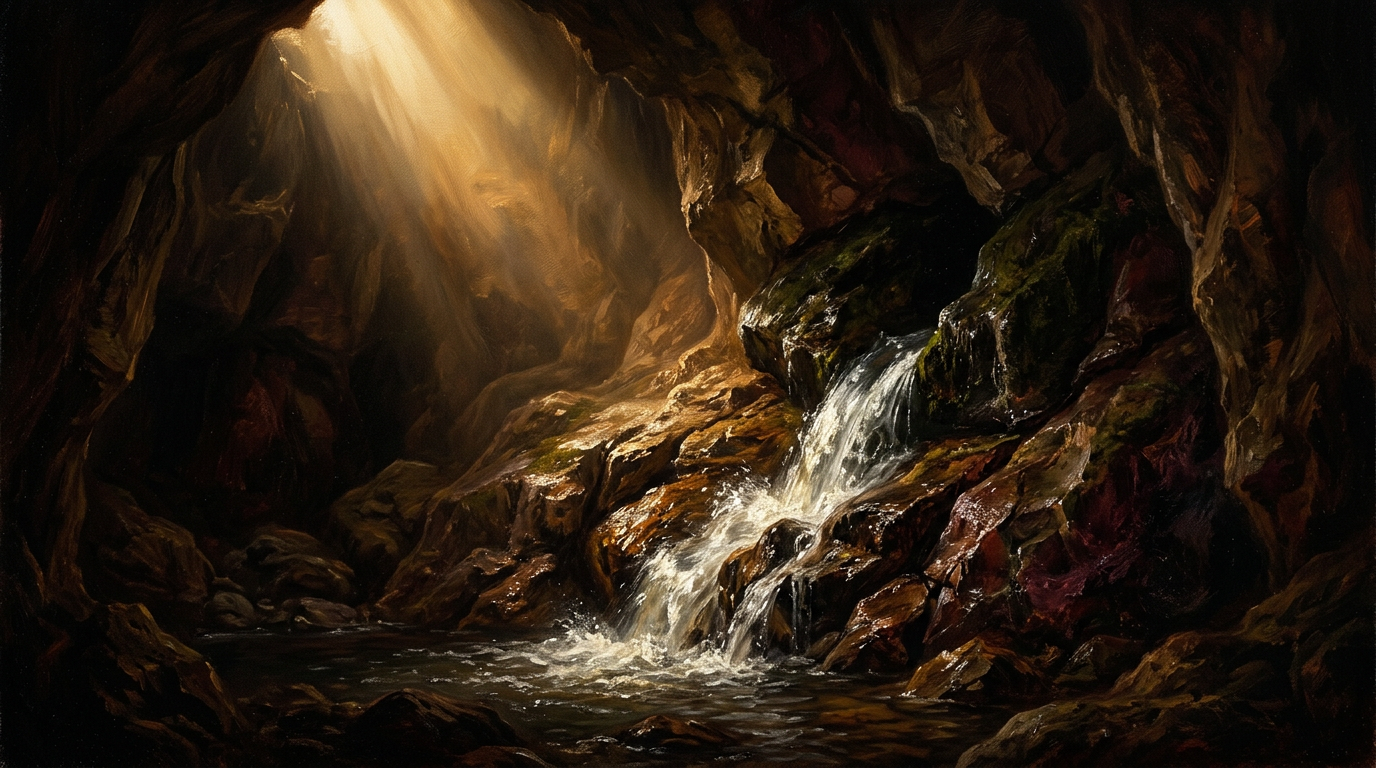
I remember times in my life when everything felt dry. Like parched land under a relentless sun. I functioned, I did what was expected of me, but in the quiet moments, I felt a deep emptiness. It wasn’t just sadness; it was the absence of something fundamental. A thirst that nothing seemed to quench.
It’s strange; you can have everything the world calls success and still feel impoverished inside. I’ve met people whose lives appeared perfect from the outside, but whose smiles never reached their eyes. We all search for that one unfailing source, for something that gives our lives weight and true meaning. We try many things, but the thirst remains.
This search is as old as humanity itself. It’s a constant back and forth, a finding and losing again. The story of Israel in the Bible is full of it: moments of deep connection with God, followed by phases where they forgot Him and went their own way. Again and again, they ended up in the same dryness. I recognise myself in that.
What I didn’t understand for a long time
I thought I just needed to try harder. Be better. Think more positively. Achieve more. I read books, tried new routines, but it was like trying to fill an empty well with a bucket that had a hole in it. It was exhausting.
The world is permeated by forces that pull at us. You can call it good and evil, light and darkness. For a long time, I tried to fight evil and emptiness by my own strength. I wanted to produce good from within myself. But how can that happen if the source is missing? It’s spiritual bankruptcy when you finally realise: nothing truly life-giving comes from me alone.
The bitter truth is that we get what we focus our thoughts on. Whoever constantly dwells on lack, injustice, and their own inadequacy will find their world grey and heavy. Whoever says, “There is nothing higher, no meaning,” experiences exactly that. A world without grace, without hope. A world that unfolds exactly as they perceive it.
And then came the moment
For me, it wasn’t a loud bang. It was a quiet surrender. An admission of my own exhaustion before God. The point where I stopped trying to do it myself and started engaging with the one who says he is life: Jesus Christ.
I began to read the Gospels, not as a duty, but as one who was thirsty. I began to talk to him, bringing my thoughts, my frustration, my emptiness before him. It feels strange to write this, and it’s not meant to sound like a simple formula. But something happened. The more I engaged with him and his words, the more my view of the world changed. And of myself.
Jesus said to him, “I am the way, and the truth, and the life. No one comes to the Father except through me.” (John 14:6)
He is the centre. He is the source. This is not some new esoteric wisdom, but the core of the Christian faith. When you align yourself with him, letting him fill your life, then change happens. Not because we make it happen, but because he works in us. It’s like placing a dried-up seed in fertile, watered soil. The growth then happens naturally.
It’s like the colours become clearer
When God enters a life, not everything suddenly becomes easy. The storms still come. But the anchor holds. The perception of the whole world changes; it is flooded with his presence. Suddenly, you don’t just see the problem, but also God’s hand in it.
By seeing him, we are changed. It’s a process. Slowly, but steadily, we become more whole. We become stronger, not through our own muscular effort, but from an inner steadfastness that he provides. Gratitude for small things grows because we recognise that nothing is to be taken for granted. The capacity to love deepens because we ourselves can draw from an infinite love.
Suddenly, it makes sense. The pain, the joy, the relationships, the work. Everything becomes a place where we can encounter God and become more like him. Life is no longer a series of random events, but a path on which we are guided by him. Back to the source.
A glimpse of the Creator
I am not a father myself. Nevertheless, I can imagine that parenthood changes one’s life in a very special way: suddenly, there is a person outside of oneself whom you love not for their achievements, successes, or behaviour – but simply because they exist.
Perhaps it’s like a part of your own heart stepping out. You bear responsibility, you worry, you rejoice in the smallest progress, and you wholeheartedly wish this person protection, freedom, and a good life. Not because you expect anything in return, but because love shows itself in giving, bearing, nurturing, and simply being there.
If human parents can feel such love – how much greater must God’s gaze upon us be? He sees not just two or three children, but billions of people. And yet, none of us is just a number in an unmanageable crowd to him. Every person is seen, wanted, and loved.
Then often comes the big question: If God is a loving Father, why does he allow so much suffering?
I believe we make it too simple if we attribute all hardship directly to God. Evil does not come from good. Violence, betrayal, greed, abuse, lies, and indifference are not expressions of God’s heart. They arise where people use their freedom against love.
True love without freedom does not exist. If God had created us only to automatically do the right thing, our obedience would not be love, but programming. Then God would not be a Father seeking relationship, but a commander controlling every movement.
Freedom, therefore, also means that we can say no: No to God, no to truth, no to love – and yes to selfishness, power, or destruction. This possibility is painful, and it has consequences. But without it, our yes to God would not be genuine either.
This does not explain every single suffering or take away anyone’s pain. There are situations for which we have no quick answers. But it reminds us that God does not stand indifferently beside suffering, nor is he its author. He takes our freedom seriously, even though it hurts him. And he remains the Father who does not cease to seek, bear, and call his children back to love.
Perhaps suffering and judging God are like an invoice. While it is still running, we see individual items, losses, outstanding amounts, and things that at first glance make no sense. But what the invoice truly adds up to in the end, we only see when it is closed – when the double line is drawn and the final sum appears at the bottom.
As long as our story and the story of this world are not yet finished, we cannot pass a complete and just judgment. We only see excerpts. But God sees the whole invoice: every pain, every injustice, every decision, but also every love, every turning back, and every step towards good.
Therefore, faith does not mean downplaying suffering or having an immediate answer to every question. Faith means trusting that God will complete the invoice – and that in the end, not evil, but his love will have the final word.