The third Advent candle is alight, but inside, everything feels grey. Outside, the high street is thick with shoppers, arms laden with bags, faces tense and drawn. You can almost feel the collective strain as an entire society tries to buy its way into a festive spirit with fairy lights and cinnamon, willing a warmth that simply refuses to arrive.
Perhaps you feel much the same. The year has been long, and the tank is empty. Work demands one final push before year-end, and instead of finding quiet, your mind is merely running through another checklist: gifts to buy, menus to plan, dates to keep.
Beneath all this pressure, there is often something heavier still. That quiet knot in the stomach about how Christmas Eve will actually go when you find yourselves round the same table once again. With the brother with whom there has been an unspoken rift for years. Or with parents around whom a single careless remark can reopen old wounds. If Advent means ‘arrival’, it can sometimes feel less like hope approaching and more like an avalanche bearing down.
Why We Long for the Garden
It helps to take a step back—away from the brochures and the expectations of what a picture-perfect Christmas ought to look like. If we are honest, Christmas has, for many, shrunk into an exhausting commercial performance. It promises us a life made whole, if only we prepare the right feast and place the right parcels beneath the tree.
This is hardly a new dilemma. At the very beginning of the human story, in Genesis 3, Adam and Eve stand before the tree. God had given them everything: a garden brimming with life. Yet the serpent whispers that they are lacking something, that they must take their happiness into their own hands, apart from God. We are still biting into that same fruit today. We still believe we can construct heaven on earth by our own strength—and then we wonder why December leaves us feeling so drained and empty.
From that ancient fracture spring our vanities, our pride, our stubborn need to be right at the family dinner table. We want to be as God, at least within our own small domain. And it was precisely there that God refused to remain a bystander.
A Child in a Manger Instead of a Glittering Facade
Down through the centuries, God declared through the prophets that He would not abandon this broken world to itself. In the midst of political turmoil and personal darkness, the prophet Isaiah penned words that serve as an anchor to this day:
For unto us a child is born, unto us a son is given: and the government shall be upon his shoulder: and his name shall be called Wonderful, Counsellor, The mighty God, The everlasting Father, The Prince of Peace. — Isaiah 9:6
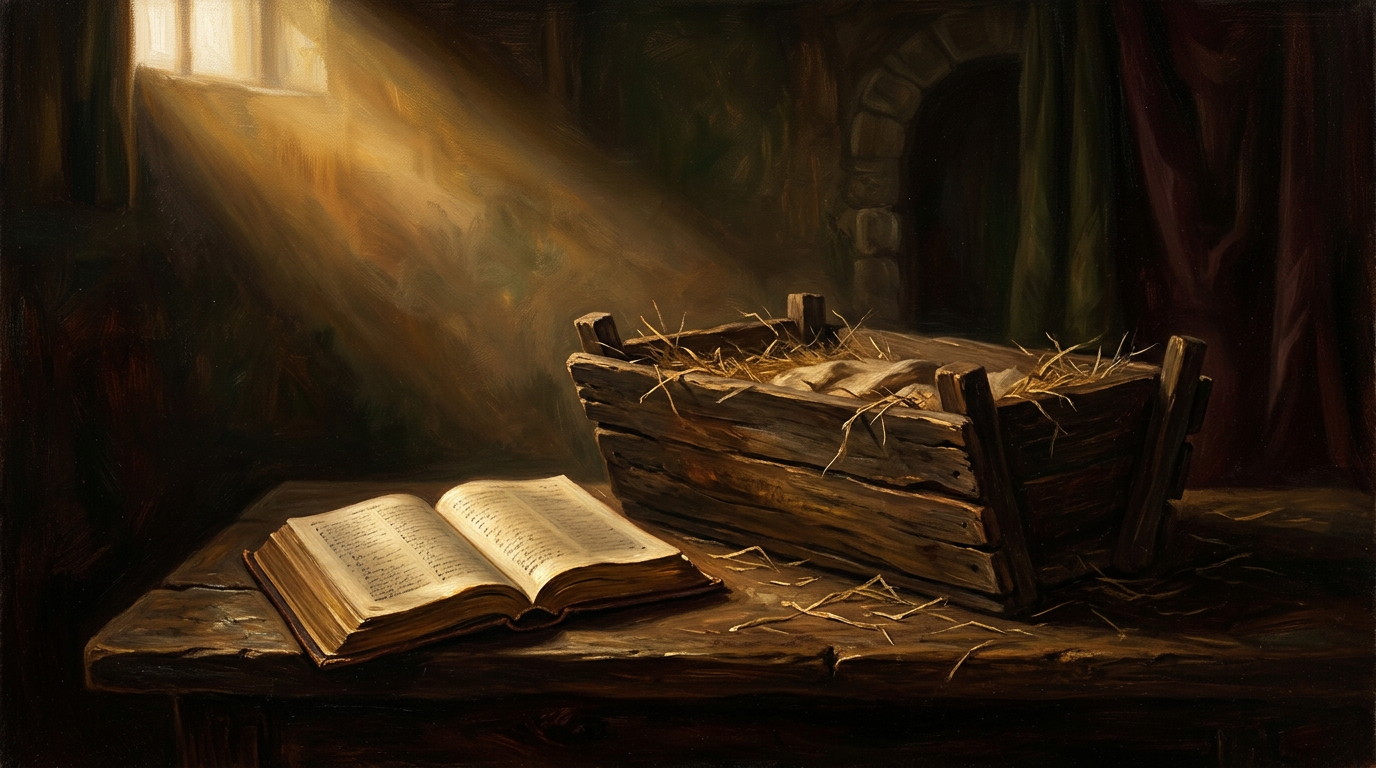
At Christmas, God does not hand us a manual for self-improvement. He gives us Himself. In Luke 2, we read how raw and unadorned that arrival truly was. No warm palace, no lavish table. A stable, the smell of animals, a young couple at the end of their tether, and a newborn laid in a feeding trough.
Jesus Christ arrives precisely where life is cramped, cold, and unfinished. In Him, God reveals the original blueprint—His true design for a life that flourishes. While we are still striving to maintain our polished facades, God descends into our dust. That takes the pressure off entirely. If the Son of God could lie in an animal’s trough, your sitting room does not need to resemble the pages of a glossy magazine on Christmas Eve.
When Old Scores Are Brought to the Table
What does this mean in practical terms for the coming days, particularly as families gather? First of all, we can afford to be realistic. Not every conflict can be untangled over candlelight between the starter and the main course.
If there is a practical, straightforward issue—a misunderstanding from recent weeks, a logistical disagreement—deal with it. Pick up the telephone before the holidays begin, and clear the air quietly. Move the stones that can actually be shifted.
Yet in many families, there are grievances that have simmered for decades. Patterns running ten or twenty years deep, where everyone knows their part and precisely which buttons to press. Here, what is needed is a clear inner resolve. You do not have to reopen old wounds at Christmas, nor do you have to step into the fray when someone else strikes a match.
Look upon your siblings or relatives as people for whom Christ came into the world just as He did for you. You can honour someone, pass them the roast potatoes, and ask kindly after their work without pretending you see eye to eye on everything. Letting an old argument lie is not hypocrisy; sometimes, it is simply charity in practice, guarding the peace of the evening.
What You Dwell Upon Grows
We hold immense sway over where we direct our attention. If you arrive at Christmas armed with a magnifying glass for other people's flaws, you are guaranteed to find them. Your uncle will talk too loudly, your mother-in-law will pass an edge into a comment about the food, the children will be overexcited.
This year, make a deliberate choice to focus on the good. Look at what is there, rather than what is missing. It might be the genuine laughter of a niece. It might simply be the fact that you have a roof over your head and a hot meal to share. Gratitude is not a pious sentiment that simply happens to us; it is a conscious decision of the will to turn our gaze.
And the angel said unto them, Fear not: for, behold, I bring you good tidings of great joy, which shall be to all people. For unto you is born this day in the city of David a Saviour, which is Christ the Lord. — Luke 2:10–11
When that night ended, the shepherds returned to the very same hard, demanding work. Their clothes still smelt of sheep, and their place on the margins of society remained unchanged. But they had seen the Saviour. That encounter altered how they looked at everything else.
We Are All in the Same Boat
Those shepherds remind us of something else, too. They were among those left out in the cold while the rest of the world slept in warm houses. Christmas acts like a magnifying glass, bringing our loneliness sharply into focus.
Perhaps you yourself face an empty chair this year—because of a bereavement, a broken marriage, or a family tie that has frayed beyond reach. That pain is real; you do not have to mask it with an easy smile. God looks upon the lonely first, just as He did on the hills outside Bethlehem.
And if you do have family or friends around you, take a moment to look beyond your own doorstep over the coming days. Who in your neighbourhood, your church, or your workplace might easily slip through the cracks? Who will be sitting alone in front of the television because the phone never rings?
As human beings, we are all in the same boat. We are all travellers dependent on grace, no matter how full or empty our sitting room may be on Christmas Eve. Often, it takes very little: an unhurried phone call, an invitation for a cup of tea on Boxing Day, or a small tin of biscuits taken round to a neighbour, accompanied by five quiet minutes of genuine conversation.
Anticipation rarely returns while we are anxiously examining our own emotions. More often, it slips quietly in through the back door when we look away from ourselves—towards the manger where God made Himself small, and towards the person beside us, who hungers for peace just as deeply as we do.