
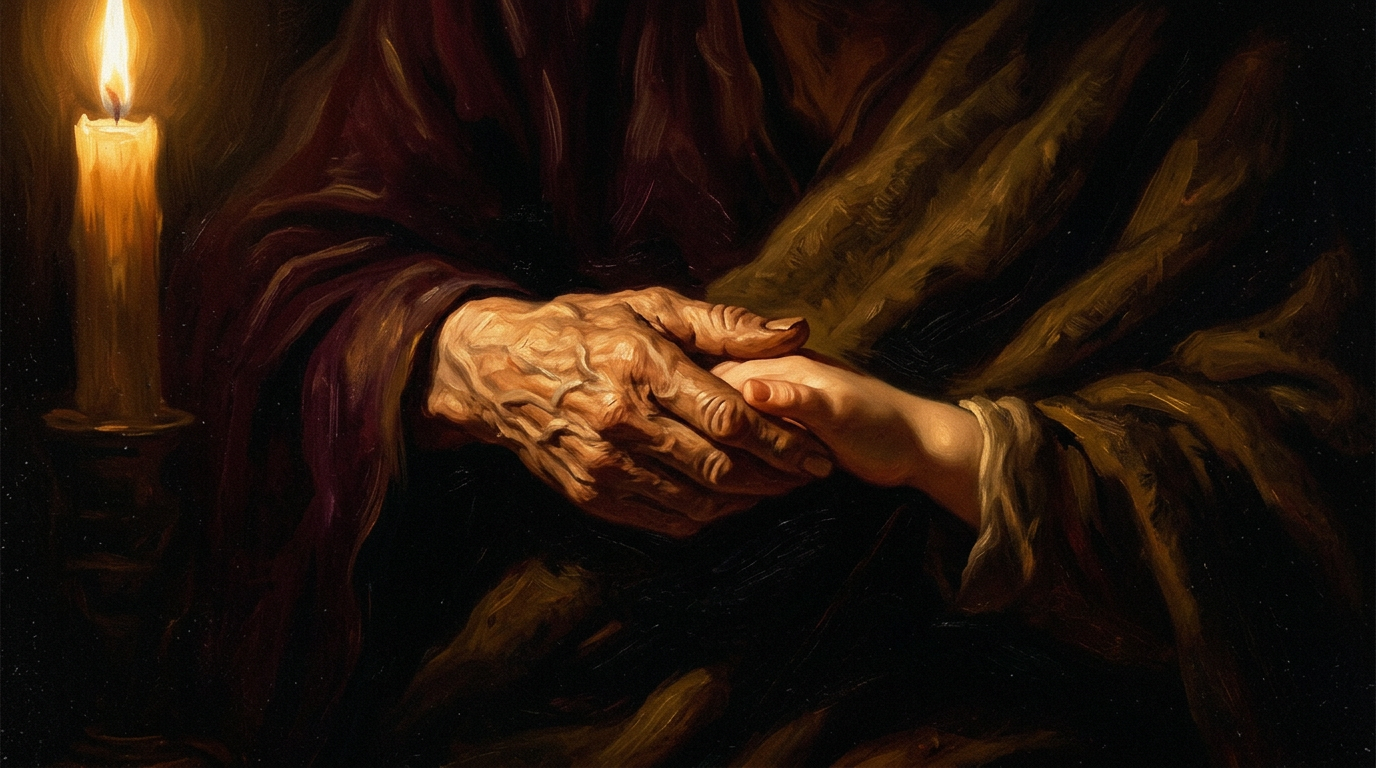
I’ve spent a long time thinking about the word "love". We use it for all sorts of things: for our partners, our children, but also for a pizza or a new car. The word is worn out, almost emptied of meaning. And if we’re honest, we often don't even mean the thing or person we claim to love.
When I say, "I love you," it's often only half the truth. The unspoken part is: "I love the feeling you give me. I love the security, the validation, the absence of loneliness." It's a transaction, an unwritten contract. I give you affection so that you’ll meet my needs. That sounds harsh and cynical, but when I’m completely honest with myself in a quiet moment, I find this mechanism at work in my heart time and again.
We all have this deep desire to be loved. It’s perhaps the most fundamental human need. Yet this longing often makes our own love needy and demanding. It becomes a tool to fill our own emptiness. But deep down, we sense that this can’t be all there is. There must be another kind of love.
The Love We Know
Look around you. Our world operates on the principle of added value. You invest time and effort in a job because you expect a salary. You nurture friendships because they bring you joy and support. None of this is bad. It’s simply how we humans function. We are wired for reciprocity and balance.
This pattern also permeates our closest relationships. We love because we hope it will lead to a better life. A partnership should make us happy. Children should bring us pride and fulfilment. Even in charity, there’s often a desire for recognition or a clear conscience. It’s a love that constantly weighs things up: What do I get back?
If the return isn't forthcoming, this love falters. The partner disappoints, the children go their own way, friends don’t have time. The sums no longer add up. What remains is resentment, hurt, and the question of whether it was truly love. This love is conditional. It is fragile.
What I've Noticed
Sometimes, something different shines through. A mother’s love for her newborn. The tiny being only demands. It robs her of sleep, cries, makes everything messy. It gives nothing back but its pure existence. And yet, there’s a love that not only endures all this but flows unconditionally. A mother loves her child because it is a part of her. It’s an almost instinctive, protective love.
But even this love can reach its limits. What, though, if someone dies for people who hate him? Who mock and betray him? What if someone gives his life, not for his friends, but for his enemies? Here, all our calculations fail. There’s no added value, no gain, no understandable reason. This is precisely what Jesus did.
He went to the cross. Not because we were so lovable. Not because he hoped for something in return. He did it when we were still his enemies, as the Bible soberly puts it. This is a love that doesn't originate with us and doesn't end with us. Its source is God alone. It wishes for nothing, demands nothing; it simply gives itself. This is the crack in our usual understanding of love. A completely different dimension.
And Then Came the Power
This love isn't just a beautiful idea. It’s a mighty power. The first Christians weren’t superheroes. They were fishermen, tax collectors, ordinary people full of flaws and fears. Peter denied Jesus. The disciples all abandoned him at the crucial moment. By human standards, their love was weak and unreliable.
What so transformed these men and women that they were later willing to endure persecution, torture, and death for their faith in this Jesus? It was their encounter with this divine love. They experienced firsthand that Jesus had conquered death. They understood that his love is stronger than betrayal, stronger than failure, stronger than death itself.
This love renewed them from within. They no longer had to earn love. They were already loved unconditionally and completely. This certainty freed them from fear. It gave them the strength to endure everything, because they knew that nothing could separate them from this love.
For I am convinced that neither death nor life, neither angels nor demons, neither the present nor the future, nor any powers, neither height nor depth, nor anything else in all creation, will be able to separate us from the love of God that is in Christ Jesus our Lord. Romans 8:38-39 (NIV)
What This Means for Us Today
We live in a different time. Most of us don't have to fear for our lives if we believe in Jesus. Our struggles are often quieter, more internal. They are the battles with loneliness, meaninglessness, the feeling of not being enough. The pressure to be lovable is ever-present.
We haven't seen Jesus with our own eyes. We can’t sit by a fire with him like the disciples. How can we experience this transformative love? It doesn't come through our own effort. We can’t meditate it into being or produce it through good deeds. The first step is honest surrender. The admission: "My love is too small. It is selfish and weak. I need yours."
This love of God is not a reward for the pious. It is a gift for the needy. It finds us where we are. In prayer, which is nothing more than an honest conversation. In reading the Bible, where his words speak to us across millennia. In community with others who also live from this gift. Wherever we open ourselves to him, his love begins to heal and transform our calculating love.
True love, then, has less to do with us learning to love better. It’s about allowing ourselves to be loved by him. Unconditionally. Completely. That takes all the pressure off our shoulders. We no longer have to fight for love. We are simply allowed to receive it. And a heart so deeply loved begins, quite naturally, to love differently. Not because it has to, but because it cannot do otherwise.